
tactic
targeting transcriptional addiction in cancer
Research Topic
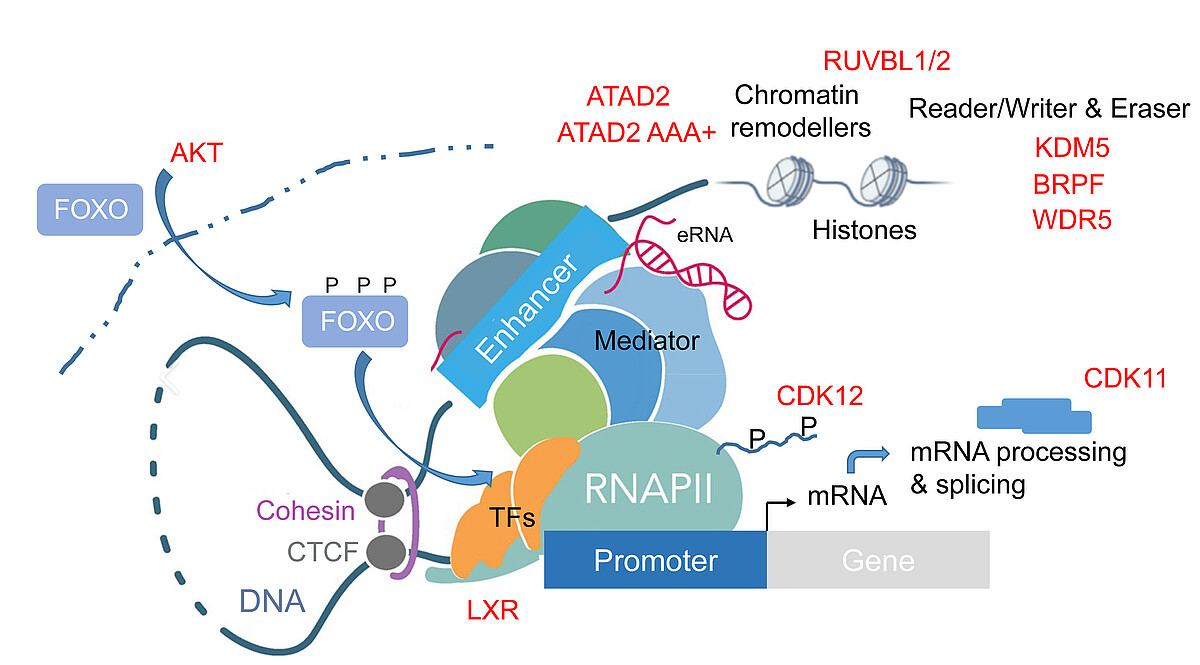
Cancer develops due to genetic and epigenetic alterations that invariably lead to dysregulated transcriptional programs. Gene expression is controlled by the combined action of transcription factors (TFs) and proteins regulating chromatin structure through epigenetic modifications on both, DNA and histones. The basal transcription machinery itself is controlled at many levels, including by a variety of post -translational modifications. Finally, also mRNA is regulated by pre-mRNA splicing events and RNA modifications, as well as mRNA-binding proteins. These mechanisms provide a rich portfolio of targets for pharmacological intervention and the development of the next generation of cancer medicines. As tumor cells require higher transcriptional rates than normal cells – termed transcriptional addiction - due to their constant progression through the cell cycle and increased proliferation, they rely on both fundamentally altered and overall increased transcription, defining the underlying cellular machinery as a priority cancer target. However, most oncogenic TFs cannot be directly targeted by small molecules. To address this challenge, we propose a program that targets transcriptional regulators that are highly dysfunctional in cancer, driving tumorigenesis. To date, the transcriptional machinery has been poorly explored by conventional drug discovery efforts, but this area has now become accessible by the development of small molecules targeting chromatin modifiers and the advent of new pharmacological modalities, such as selective protein degraders (PROTACs). Transcriptional regulators belong to diverse target families, allowing us to establish a risk-balanced project portfolio, ranging from “low risk” drug target families, such as protein kinases and nuclear receptors (LXR), to more challenging targets such as protein-protein interaction surfaces. Importantly, the selected targets or targeting strategies have not been in the primary focus of industrial drug development programs. The proposed portfolio comprises kinases (CDK11, CDK12, AKT (covalent allosteric)), chromatin-modifying enzymes (e.g. KDM5, BET-HDAC (dual inhibitor)), and the more challenging targets, such as protein-interaction domains and AAA-domain/ATP hydrolases (e.g. WDR5, BRPF, ATAD2). In addition to conventional small-molecule inhibitors, we also
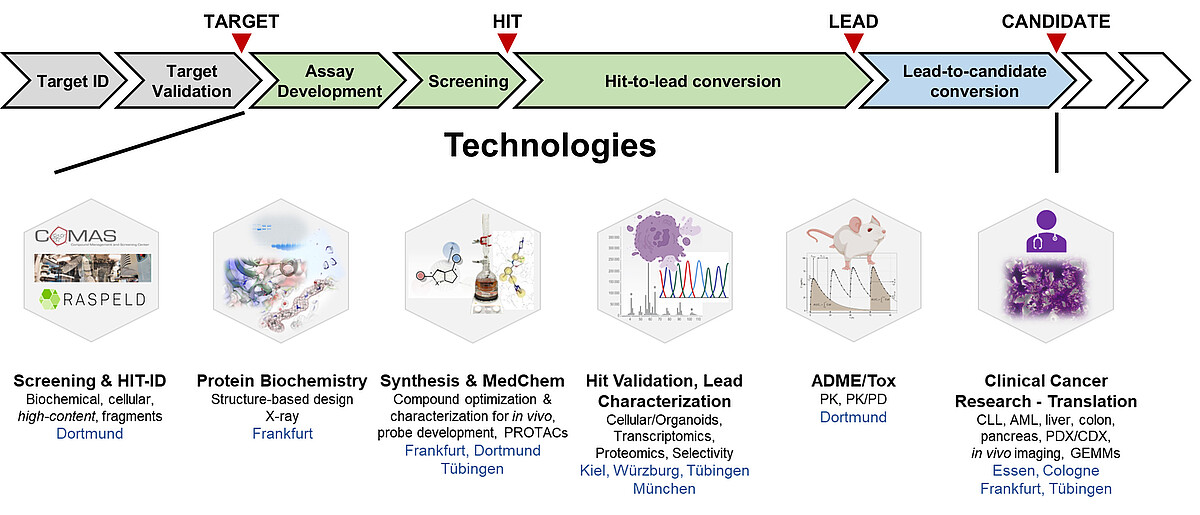
propose to develop new pharmaceutical modalities, such as selective protein degraders (PROTACs). In order to carry out this ambitious program, we established a network of state-of-the-art cancer and drug development laboratories, creating the national oncology drug discovery hub (Targeting transcriptional AddiCTion In Cancer, TACTIC). This hub comprises experts, covering all aspects of drug discovery, including high-throughput screening (MPI Dortmund), assay development and rational inhibitor design by highthroughput structural biology (Frankfurt), medicinal chemistry groups (Tübingen, Dortmund), expertise in PROTAC development (Frankfurt, Würzburg), chemical proteomics (Munich), ADME/Tox studies (Dortmund, Tübingen), the integrated drug discovery & development platform TüCADD (Tübingen), as well as a network of disease experts, covering the major tumor types with mechanistic and patient-derived cellular and in vivo models (Cologne, Essen, Tübingen, Frankfurt). Thus, the consortium incorporates partners that ultimately generate a fully functional experimental drug discovery value chain. Development of small molecules is envisioned to reach the drug candidate stage, and further clinical development will be realized by collaborating translational networks (CCC network, NCT, DKTK), charities (M4K), and industry partners. All participating research groups have a long-standing interest in cancer-specific transcription control, and a proven track record of ongoing collaborations, including all key technologies required for the proposed program.
Project Team


Prof. Dr. Stefan Laufer
Co-Speaker
Pharmaceutical and Medicinal Chemistry, Eberhard-Karls-Universität Tübingen


Prof. Dr. Christian Reinhardt
Speaker of the joint preCDD Consortia
University Hospital Essen Department of Hematology and Stem Cell Transplantation, Essen


Prof. Dr. Christian Brandts
UCT Freiburg-Marburg, University Cancer Center
Director

Prof. Dr. M. Eilers
Julius-Maximilians-Universität Würzburg Theodor-Boveri-Institut, Chair of biochemistry and molecular biology
Group Leader

PD Dr. Henner Farin
Georg Speyer Haus Institute for Tumor Biology and experimental Therapy, Frankfurt
Group Leader

Prof. Dr. Matthias Gehringer
Eberhard Karls Universität Tübingen, Pharmaceutical and Medicinal Chemistry

Dr. Florian Greten
Georg-Speyer-Haus Institute for Tumor Biology and experimental Therapy, Frankfurt
Director/ Research Group Leader


Dr. Andreas C. Joerger
Goethe University, p53 Drug Discovery and Transcriptional Regulation, Frankfurt
Principal Investigator


Dr. Susanne Müller-Knapp
SGC Frankfurt Goethe Universität Frankfurt Buchmann Institute for Molecular Life Sciences Frankfurt Cancer Institute Honorary member Institute for Cancer Research
Chief Operating Officer

Prof. Dr. Sina Oppermann
Georg Speyer Haus, Institute of Pharmacology and Clinical Pharmacy, Frankfurt
Research Group Leader


Prof. Dr. Jens Siveke
Universitätsmedizin Essen, Westdeutsches Tumorzentrum, Deutsches Krebsforschungszentrum (DKFZ)


Institutions











Publications
- Adhikari, B., K. Schneider, M. Diebold, C. Sotriffer, and E. Wolf, Identification of suitable target/E3 ligase pairs for PROTAC development using a rapamycin-induced proximity assay (RiPA). Elife, 2024. 13.
- Kramer, A. and S. Knapp, Elimination of mutant SWI/SNF complexes by protein quality control: new opportunities targeting aggressive rhabdoid tumours. Signal Transduct Target Ther, 2024. 9(1): p. 224.
- Vogt, M., N. Dudvarski Stankovic, Y. Cruz Garcia, J. Hofstetter, K. Schneider, F. Kuybu, T. Hauck, B. Adhikari, A. Hamann, Y. Rocca, L. Grysczyk, B. Martin, A. Gebhardt-Wolf, A. Wiegering, M. Diefenbacher, G. Gasteiger, S. Knapp, D. Saur, M. Eilers, M. Rosenfeldt, F. Erhard, S.M. Vos, and E. Wolf, Targeting MYC effector functions in pancreatic cancer by inhibiting the ATPase RUVBL1/2. Gut, 2024. 73(9): p. 1509-1528.
- Sflakidou, E., B. Adhikari, C. Siokatas, E. Wolf, and V. Sarli, Development of 2-Aminoadenine-Based Proteolysis-Targeting Chimeras (PROTACs) as Novel Potent Degraders of Monopolar Spindle 1 and Aurora Kinases. ACS Pharmacol Transl Sci, 2024. 7(11): p. 3488-3501.